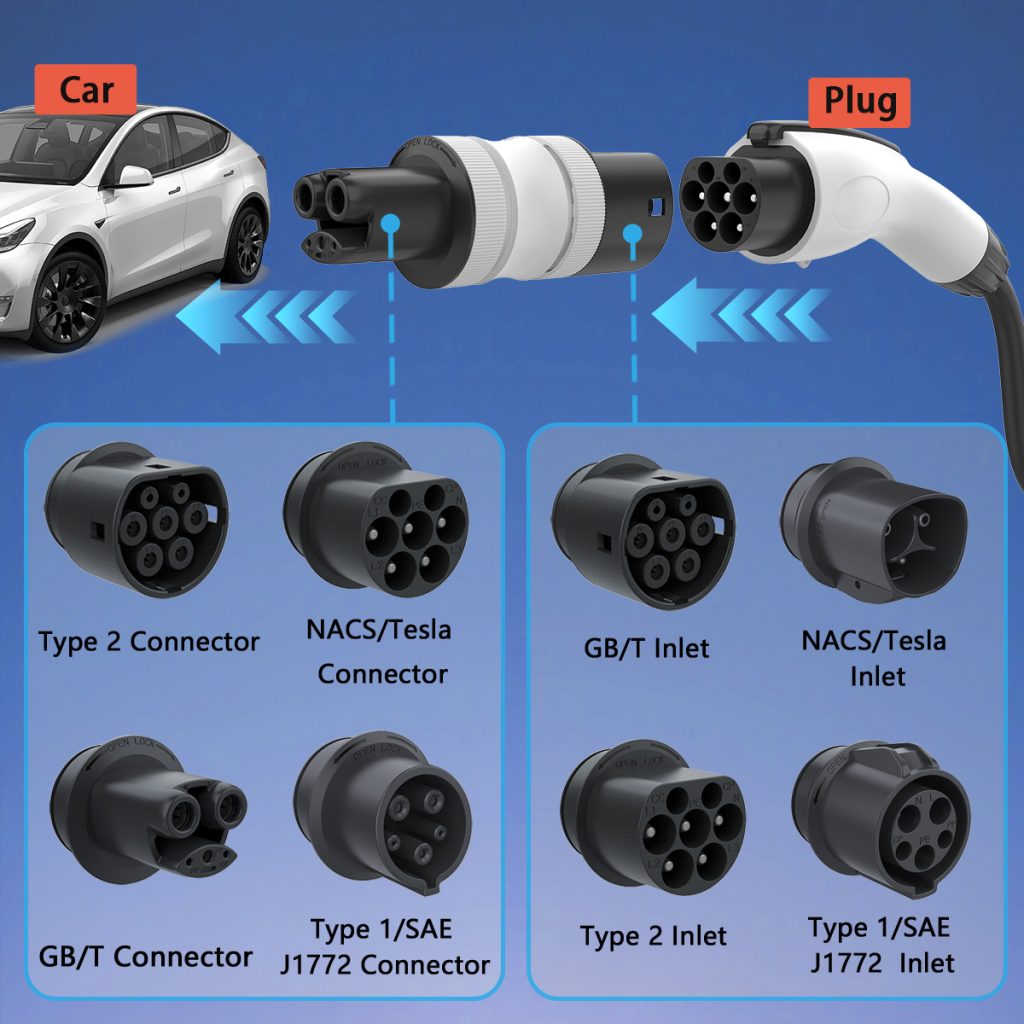
As electric vehicles (EVs) gain global popularity, incompatible charging connectors have become a major hassle for many owners—finding a charging station only to be unable to charge due to mismatched ports. In fact, there are five mainstream EV charging connector standards worldwide, and with the right adapters, you can access nearly all charging scenarios. Below is a detailed breakdown.
This is the core charging connector standard in China, available in both AC and DC versions. The AC connector features a 7-terminal structure with power ranging from 3kW to 22kW, ideal for slow charging at home or offices. The DC connector adopts a 9-pin design supporting ultra-fast charging up to 350kW, making it the primary choice for public fast-charging stations. Domestic models like BYD, Xpeng, NIO, Li Auto, and Tesla’s China-made Model 3/Y all use this standard.
Consisting of two variants—CCS1 (North America) and CCS2 (Europe)—this standard adds DC fast-charging contacts to the Type 2 AC connector. CCS2 is widely adopted in European models, while some imported Volkswagen, BMW, and Audi EVs in China still use this standard. Its AC mode supports 3.7kW-22kW, and DC mode enables fast charging up to 150kW.
Derived from the SAE J1772 Combo Connector, the CCS standard unifies AC and DC charging into a single port, adopted by major automakers including Audi, BMW, Ford, and Mercedes-Benz . Learn more about the SAE J1772 technical specifications here:
http://www.shturl.cc/bf10f0e60eff73d76d8d97de43e7da66Primarily used for AC charging in European brands, this 7-pin connector covers 3.7kW-22kW power output. Data shows 68% of mainstream EVs in China (including some domestic models) are equipped with Type 2 AC ports, making it a universal choice for slow charging . It serves as the foundation for the CCS2 standard, ensuring cross-compatibility across European charging networks.
Named from “CHArge de Move” (meaning “charge in the time of a tea break”), this 9-pin connector was once the dominant fast-charging standard for Japanese EVs. Imported models like Toyota bZ4X, Lexus RZ, and Nissan Ariya still use it. Early versions supported 50kW, while the latest CHAdeMO 3.0 protocol enables ultra-fast charging up to 900kW (600A current, 1.5kV voltage) .
Its CAN bus communication interface ensures stable and reliable charging, with widespread adoption in Japan and compatibility with global fast-charging networks. For more details on the standard, visit the official CHAdeMO Association resources.
Tesla initially developed a proprietary connector for North America, now known as the North American Charging Standard (NACS). It features no moving parts, lightweight design, and supports both AC and DC charging at maximum speeds . Tesla’s Supercharger network—accounting for 75% of fast chargers in North America—has driven widespread adoption of NACS by major automakers including Ford, GM, Volvo, and Mercedes-Benz .
While Tesla’s China-made models have switched to GB/T and European models to CCS2, older imported Tesla vehicles require adapters for public charging. Learn about Tesla’s NACS expansion and adapter support here:
http://www.shturl.cc/15a24eb23fec6315e4e9fc6d1441b45f
- Core function: Converts DC power from European standard fast-charging stations to AC power for Type 2-equipped vehicles via internal inverter circuits.
- Application: Compatible with 42% of public DC fast-charging stations in China using CCS2, resolving “charging blind spots” for owners of Type 2-equipped EVs (e.g., some BYD and Xpeng models) .
- Key specs: 3.7kW-22kW output, IP65 protection rating, over-voltage/over-current/over-temperature protection, priced between $55-$83.
- Notes: Avoid frequent fast-charging or high-voltage DC use. Choose CE-certified products with heat dissipation fins to prevent electronic control module damage.
- Core function: Seamlessly connects Japanese EVs with CHAdeMO ports to China’s mainstream GB/T DC charging stations.
- Application: Ideal for owners of imported Japanese EVs (Toyota, Lexus, Nissan) during cross-country travel, compatible with most public fast-charging stations in China .
- Key specs: Supports up to 350kW ultra-fast charging, 200V-1000V voltage range, IP67 protection rating, 99.6% communication success rate.
- Notes: Unnecessary for domestic Chinese models. Select products with national standard certification and NTC temperature sensors to avoid safety hazards.
- Core function: Converts older Tesla’s proprietary NACS ports to GB/T or CCS2 for access to public charging networks.
- Application: Essential for owners of early imported Tesla models charging at public stations globally.
- Key features: Tesla’s official adapters offer dual-mode compatibility (AC slow charging + DC fast charging), while third-party adapters require careful power matching .
- Core function: Converts AC power from home or public slow-charging stations to DC power for EV charging.
- Application: Emergency charging when DC fast-charging stations are unavailable during long trips.
- Notes: Low power output (≤7kW) results in slow charging speeds, best suited for overnight charging.
- Match power requirements: Choose adapters based on your vehicle’s maximum charging power to avoid inefficient charging or safety risks.
- Prioritize safety certifications: Select products with CE, RoHS, FCC, or national standard certifications, ensuring built-in protection against overheating, over-voltage, and over-current.
- Check protection ratings: Opt for IP65+ rated adapters for outdoor use, preferably with sealed silicone gaskets for resistance to rain and snow.
- Confirm vehicle compatibility: Domestic Chinese models don’t need CHAdeMO-to-GB/T adapters, while Type 2-equipped vehicles don’t require Tesla NACS adapters—avoid unnecessary purchases.
While global standardization of EV charging connectors is an industry trend, the current coexistence of multiple standards makes adapters a necessary transitional solution. Choosing the right adapter ensures full utilization of public charging networks and eliminates range anxiety.

Deprecated: File Theme without comments.php is deprecated since version 3.0.0 with no alternative available. Please include a comments.php template in your theme. in /home/bytemoul/evolado.com/wp-includes/functions.php on line 6260